














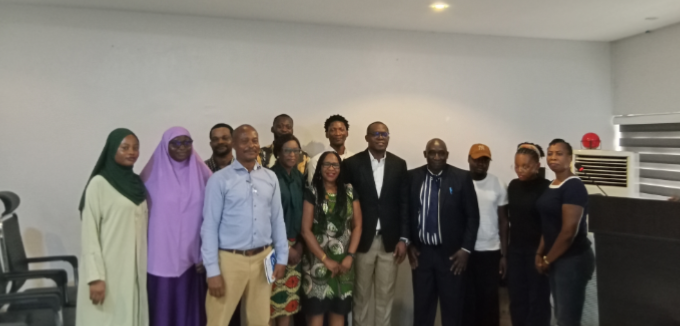
Worried by the consequences of air pollution on human health and the danger posed to the environment, Air Quality Monitoring Research Group (AQMRG), University of Lagos (UNILAG), in conjunction with RENACLIP Foundation, and Lagos State Environmental Protection Agency (LASEPA), has taken the campaign for quality air to secondary schools in Lagos.
Lead, Air Quality Monitoring Research Group (AQMRG), University of Lagos (UNILAG), Prof Rose Alani, while speaking during the official launch of the Air Quality Clubs in Lagos School at Alausa Ikeja on Wednesday, said the aim was to provide students with air quality information, basic monitoring approaches, and the identification of pollution sources around their schools and communities.
The overall aim of the club in Lagos schools, according to Prof. Alani, is to educate and empower students to understand air pollution and its health and environmental impacts, promote clean air practices, and actively participate in air quality awareness, monitoring, and advocacy within their schools, homes, and communities
Prof. Alani listed the specific objectives to include: Environmental education, Increase students’ knowledge of air pollution, its sources, health effects, and environmental consequences.
Prof Alani, who noted that the initiative is not limited to Lagos schools, added: “Our long-term vision is to expand the Air Quality Clubs initiative nationwide. Lagos State, as a center of excellence and a pace-setter in environmental management and innovation, provides an excellent starting point for developing a model that can be replicated across other states in Nigeria.
“Through the collaboration of AQMRG, University of Lagos, RENACLIP Foundation, and LASEPA, we aim to establish a strong foundation in Lagos by equipping students with knowledge of air pollution, its health and environmental impacts, air quality monitoring, heat-pollution risks, and practical measures for protecting their health and environment.”
She advised teachers in the selected schools is to see the Air Quality Clubs not merely as another extracurricular activity, but as an opportunity to shape the attitudes, knowledge, and environmental consciousness of the next generation.
General Manager, LASEPA, Dr. Tunde Ajayi, said that it was necessary to educate students on the dangers of air pollution and prepare them as champions of healthy environment.
Saying that everything that is done in the society is tied to the environment, Ajayi urged the students to make deliberate efforts to protect their environments.
He also advised them to go back to their various schools and houses and become champions of clean air wherever they find themselves.
Director, Air Quality and Emissions Control Unit, Lagos State Environmental Protection Agency (LASEPA), Ayodele Oso, said that the program enabled the agency to relate with the students on how to tackle the problem of air pollution, as air pollution is a collective responsibility.
She said that the young ones should not be excluded because they are the more vulnerable to air pollution. “When we are able to explain what it is, the impact of air pollution upon their health and they have this environmental education, they will be able to have a better change.“
Oso noted that the club aims to help students identify sources of air pollutions, understand its effects, and share accurate information and encourage environmental responsibility behaviors in our schools, homes, and communities.
She tasked teachers and the club coordinators on the need to guide and help the students organize and engage in activities that will turn the lesson learnt from the orientation into practical actions within their schools.
Saying that LASEPA recognizes that protecting the environment requires collective responsibility, Oso added: “Government agencies cannot address every challenge alone. Schools, parents, communities, researchers, organizations, and young people all have important roles to play in these clean air actions.”
“Our goal is not simply to establish clean air clubs on paper, but to build active clubs that will promote awareness, encourage positive behaviors, and contribute to a cleaner, healthier school environment.
“Remember, the air we breathe connects us all, and protecting it is a responsibility we share. Let your voice, your ideas, your actions inspire your schools and environment to make a clean air a priority.”
Prof. Vincent Osunkalu, of the College of Medicine, University of Lagos, also educated the students on the dangers of air pollution to human health and the need for them to make deliberate efforts to protect the environment by telling their families and friends on what to do and how to protect the environment.
Club Coordinator, Charles Chinedu Ndu, of RENACLIP Foundation, said that the idea of picking students is because “they are the ones that carry the torch who can explain to the elders that polluting the air is wrong. Because it’s difficult.
“When you catch them young and build with them, and they understand the effects of what they are doing, you tend to change some characters within the environment.”
Ndu, who lamented that human activities in the areas of burning bush, waste management, are affecting the environment, said: “By the time you start teaching the younger ones the implications of air pollution, they tend to grow with it.