













The Lagos State government has restated its commitment to strengthening the systems for prevention, early intervention, protection, access to justice, rehabilitation and support for victims of domestic and sexual violence (DSV) survivors.
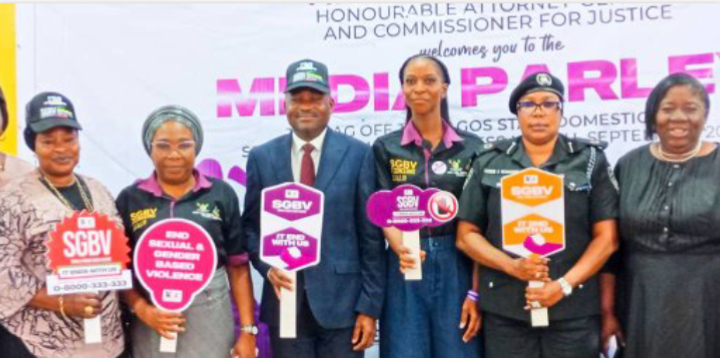
The state Attorney General and Commissioner for Justice, Lawal Pedro, disclosed this on Monday at Alausa, Ikeja, at a media parley marking the beginning of the 2026 Domestic and Sexual Violence Awareness Month.
Pedro, who was represented by the Executive Secretary of the Lagos State Domestic and Sexual Violence Agency, Titilola Vivour-Adeniyi, said that 35 percent of survivors experienced domestic violence within the first five years of marriage, adding that another 30 percent of female survivors reported abused while pregnant, highlighting the vulnerability of women during pregnancy.
He noted that domestic violence accounts for 75.5 percent of reported assaults involving adults, making it the most common form of abuse recorded, adding that domestic violence cuts across income levels, with 76 percent of alleged perpetrators either employed or self-employed.
He noted that over 711 cases were taken to court, resulting in more than 160 convictions, while 175 survivors received free legal assistance.
It also provided psychological support to 953 survivors, 267 perpetrators and 304 children, and carried out 501 rescue operations involving people considered to be at high risk, he added.
Pedro said that 76 percent of alleged violence perpetrators are either employed or self-employed, showing that domestic violence is not limited to families facing economic hardship, adding that domestic violence accounts for 75.5 percent of reported adult abuse cases, while emotional abuse makes up 82.3 percent of cases involving children.
Pedro stated that it recorded 33,009 cases of domestic and sexual violence between September 2021 and July 2026, with domestic violence accounting for the highest number of reported cases.
He said the figure, compiled by the Lagos State Domestic and Sexual Violence Agency (DSVA), represented cases reported through physical walk-ins and the Virtual Referral and Response Service (VRRS), averaging more than 300 clients monthly.
According to him, the cases included 13,515 incidents of domestic violence, 1,171 cases of defilement, 797 cases of child abuse and physical assault, 420 rape cases, 428 cases of sexual harassment and 100 cases of sexual assault by penetration.
He added that the Agency also recorded 95 cases of technology-facilitated sexual and gender-based violence, 323 threats to life, 79 attempted rape cases and 1,861 family-related issues such as custody, neglect, abduction and child labour.disputes involving
Pedro, however, described as particularly disturbing the 10,613 children identified as having suffered emotional abuse as a result of exposure to domestic violence in their homes.
He said the figure underscored the need for government and stakeholders to look beyond the immediate victims of violence and address the psychological and emotional consequences on children who witness violence within their homes.
“Behind every number is a person, a family and, often, a story of trauma, courage and the search for justice,” Pedro said, stressing that the government’s responsibility was to ensure that every victim was heard, every survivor supported and every perpetrator brought within the ambit of the law.
Giving a year-by-year breakdown, Pedro said DSVA recorded 1,075 cases between September and December 2021, 5,929 in 2022, 6,389 in 2023, 7,882 in 2024, 7,721 in 2025 and 4,013 cases as of July 2026.
He noted that the comparative data showed a 23.6 per cent decline in reported cases, with male reporters decreasing by 47.8 per cent and female reporters by 28 per cent.
Women, however, continued to constitute the overwhelming majority of reporters, accounting for 88 per cent, while men represented 12 per cent.
Pedro cautioned against interpreting the decline in reported cases as an automatic indication that the prevalence of sexual and gender-based violence had fallen by the same proportion.
He explained that reporting figures could be influenced by awareness levels, reporting behaviour, access to services and changes in the channels through which survivors sought assistance.
“Our ambition is not simply to see fewer cases appearing on our database. Our ambition is to see fewer people experiencing violence in the first place,” he said
The Commissioner disclosed that the state had continued to strengthen its legal, medical and psychosocial responses to reported cases.
He said 175 survivors received free legal support through DSVA’s in-house lawyers, the Office of the Public Defender, private law firms and the Lagos Public Interest Law Partnership.
He added that more than 711 cases were charged to court, while the Directorate of Public Prosecutions in the Ministry of Justice secured over 160 convictions within the period under review.
According to him, the state also financially supported the investigation and prosecution of 464 SGBV-related cases and obtained 20 restraining orders under the Lagos State Protection Against Domestic Violence Law 2015.